

We are working with small communities to enact development rules that will protect our rivers, lakes and streams. Learn more about this project and why managing stormwater is vital to clean water.
The Council received a grant from the Michigan Department of Environmental Quality to implement projects recommended in our 2011 watershed management plan (WMP). The first project involves a collaboration with smaller municipalities in the watershed to evaluate how they collect and manage stormwater. We are presenting communities with policy options that will protect water quality and control future infrastructure costs.
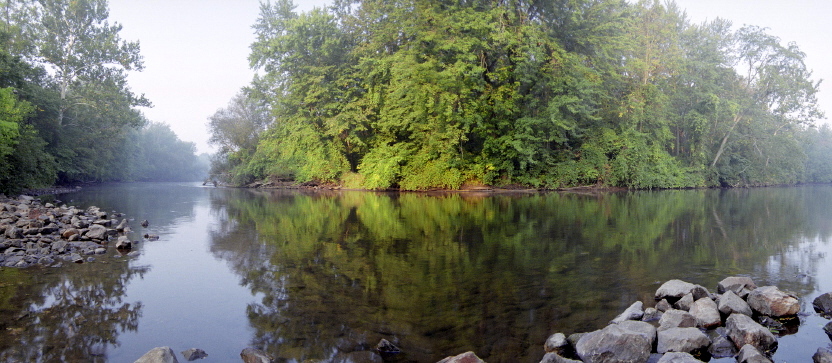
The second project involves pathogen monitoring in the Davis Creek Watershed, a subwatershed to the Kalamazoo River. The Council is working with Michigan State University to track the origin of water-borne pathogens to specific sources, such as humans or cows. Once we know where the pathogens are coming from, we can work with the public and municipalities to correct these problems, leading to a healthier creek and community.
Background
Urban stormwater was identified in the WMP as a major source of pollution, in the form of phosphorus and sediment, to the Kalamazoo River. Excessive phosphorus and sediment cause undesirable water quality impacts, such as algal blooms, low water visibility, low dissolved oxygen, and a carp-dominated fishery. Modeling and water quality sampling conducted to investigate sources of pollutants to the river system indicate urban stormwater contributes a disproportionate amount of phosphorus to Lake Allegan relative to the land area of urban development (see Total Maximum Daily Load program for the Lake Allegan Watershed). We also know that about 50% of the nonpoint source load of phosphorus originates in urban areas, which make up less than 8% of the drainage area but are mostly situated along the main rivers.
To address both the current and future impacts of stormwater, the Council is developing and testing a stormwater pollution prevention education program for priority communities in the Lake Allegan Watershed. With assistance from a local partnership of municipal leaders and conservation organizations (i.e., TMDL Implementation Committee), several communities that are not regulated under the federal stormwater permit program are working with the Council to evaluate their current stormwater policies. We are providing stormwater information and specific feedback based on their administrative rules to local officials and their planning teams. The main goal of this project is to encourage all watershed communities to understand the linkages between land and water, understand the cost/benefit balance of effective stormwater management, and to take action to protect and improve the health of our lakes and rivers.
The second project the Council is implementing under this grant is an investigation in the Davis Creek Watershed using microbial genetic source tracking methods. The laboratory of Dr. Joan Rose at Michigan State University will be assisting with water quality sampling, experimental design, and molecular analysis. The experimental design will incorporate source identification methods that will be useful for assisting us in identifying and correcting problems that introduce pathogens into our water. Faced with the possibility of new regulations due to high levels of pathogens, we hope the results of this project will provide more insight into both the degree of the problem and potential solutions. The Council strongly feels that before selecting on-the-ground management activities, source tracking must be used in order to understand which actions might best address the problem.